
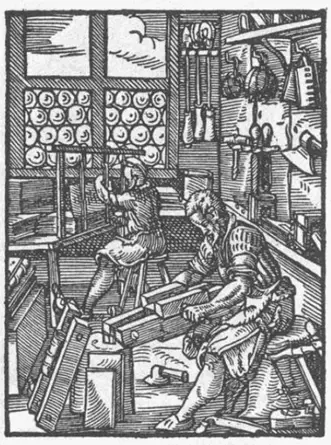
The bookbinder was responsible for the completion of books after the printing process finished. Among other things, he would make sure that the paper printed was gathered, cut, bound, and made into finished books.
After the sheets of paper was gathered up it then had to be folded and cut up. One sheet of paper was first folded in the middle and then folded up. One sheet of paper could make up to eight pages. Usually after being printed, the sheets had uneven corners that had to be cut. They were placed on a solid surface, most often a wooden board or a thick leather backing. The knife was then lowered along the edge of the pile.
After having cut the page, they could commence to the process of binding the pages. The pages were gathered into a unit called a book block. It was important for the pages to be arranged in the correct order. A needle and thread were used to sew the sheets together and make a book. A binding needle was most commonly used for this process. The thread usually consisted of linen or silk. The books were sewn by putting the needle through the spine of the book block. This helped keep the sheets stable. When the book block was sewn together then the spine had to be completed. This was done by applying a thick layer of glue, making a hard surface that kept the sheets together.
The leather cover was applied with glue, it was then folded around the book, pressed, and tightened. Usually, strings and ribbons were used and wrapped around the book.