
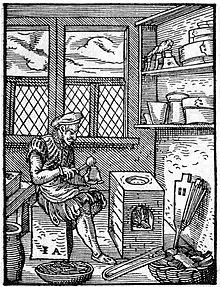
The type-smith, or the stamp maker, played an important role in the early days of printing in 15th century Europe.
Perhaps the single most important process Gutenberg invented in the series of sub-techniques, is the method of production with loose types, which resulted in revolutionizing the printing process. This process was in addition to being of use to the people was also easy to learn. He used low-melting alloys of lead, tin, and antimony. Tin makes the alloy more fluid, and makes it so that it cools faster and is more durable.
It was the type-smith that produced the stamps used to make the individual types of letters used in a text. Up until then all books had been copied by hand. The process was time consuming and production was low, despite the high cost.
The type-smiths task was to produce stamps for each letter and symbol that was to be used in the text. The stamps were rods made of steel with an image of the letter that was to be printed on the paper or parchment.
When the stamps were done, they were then used to make a matrix, a small mold. This was done by striking the steel stamps into a metal rod made of copper, which is a softer type of metal. This resulted in a negative impression of the letter or symbol on the stamp. The matrix was a small mold that made it possible to produce a huge number of different letters quickly and effectively.